Histoire du peuple Yasuku
History of the Yasuku People
De l'Égypte ancienne aux rives de la Sanaga — mille ans de migrations, d'alliance et de résistance.
From ancient Egypt to the banks of the Sanaga — a thousand years of migrations, alliance, and resistance.
L'Égypte, l'Éthiopie, le lac Tchad — et la Sanaga
Egypt, Ethiopia, Lake Chad — and the Sanaga
La mémoire orale la plus profonde des Elog Mpoo affirme une origine en Égypte ancienne et dans les régions du lac Tchad. Nos ancêtres ont traversé l'Éthiopie et les hauts plateaux camerounais avant de s'établir sur la côte de la Sanaga. Ce n'est pas une revendication marginale — elle est attestée par plusieurs témoins oraux conservés dans des sources académiques publiées.
The deepest layer of Elog Mpoo oral memory asserts an origin in ancient Egypt and the regions of Lake Chad. Our ancestors passed through Ethiopia and the Cameroonian highlands before settling on the Sanaga coast. This is not a marginal claim — it is attested by multiple oral witnesses preserved in published academic sources.
« Nous, les Bakoko, sommes partis d'Éthiopie, puis nous avons traversé l'Égypte. De là, notre grand ancêtre est parti avec d'autres et est arrivé près de Yaoundé. En ces temps, les anciennes routes de Dieu étaient plus courtes. Notre grand ancêtre Nsoo trouva un vaste rocher parmi les Basso du Nord. » — Jean Toto Kange, catéchiste (mort le 10 juillet 1978, à environ 110 ans) — déclaration de 1976
"We, the Bakoko, left from Ethiopia, then passed through Egypt. From there, our great ancestor departed with others and arrived near Yaoundé. In those times, the ancient roads of God were shorter. Our great ancestor Nsoo found a vast rock among the Basso du Nord." — Jean Toto Kange, catechist (died July 10, 1978, at approximately 110 years of age) — 1976 testimony
Ces témoignages sont conservés dans les appendices imprimés de Christine Buhan et Etienne Kange Essiben, La mystique du corps (L'Harmattan, 1986) — des témoignages de personnes nées au XIXe siècle, enregistrés au XXe siècle, et maintenant préservés en écriture.
These testimonies are preserved in the printed appendices of Christine Buhan and Etienne Kange Essiben, La mystique du corps (L'Harmattan, 1986) — testimony from people born in the 19th century, recorded in the 20th, and now preserved in print.
Ngog Litua — Le Rocher Percé
Ngog Litua — The Perforated Rock
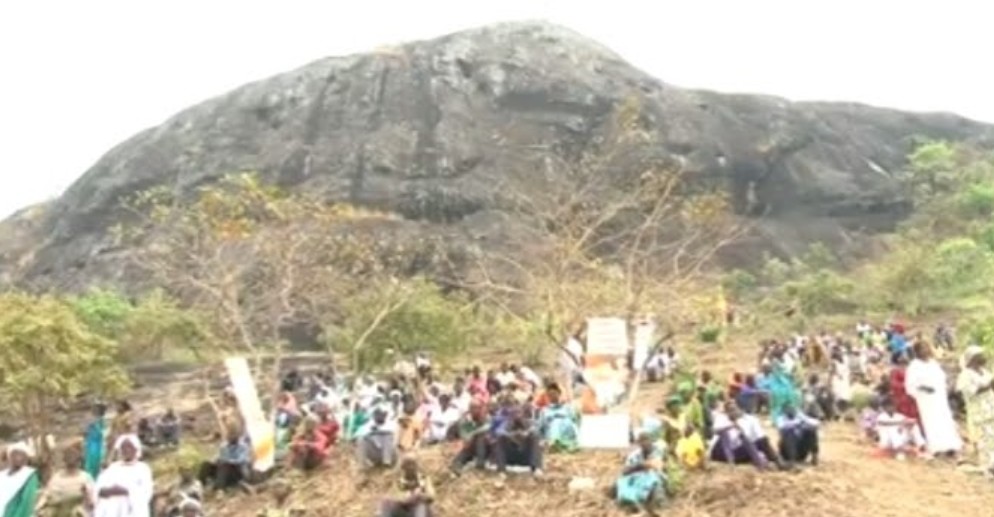
Ngog Litua (aussi Ngog Lipondo en Bakoko, signifiant « le rocher percé » ou « rocher avec un trou ») est une montagne-grotte située à 80 km d'Edéa, dans la commune de Nyanon, Sanaga Maritime. C'est le site fondateur sacré des Elog Mpoo — le lieu où la tradition orale situe la dispersion des clans après une période d'existence commune.
Ngog Litua (also Ngog Lipondo in Bakoko, meaning "the perforated rock" or "rock with a hole") is a mountain cave located 80 km from Edéa, in the commune of Nyanon, Sanaga Maritime. It is the sacred founding site of the Elog Mpoo — the place where oral tradition places the dispersal of the clans after a period of shared existence.
Ngog Litua est considéré comme « le berceau des peuples Elog Mpo'o, Bassa, Duala et Bati ». Des pèlerinages annuels ont été formalisés en 1952, bien qu'ils précèdent de loin cette formalisation. Le site a acquis une consécration catholique de l'Évêque de Douala cette année-là — un acte que la mémoire communautaire décrit comme une « christianisation » d'un lieu sacré ancestral.
Ngog Litua is considered "the cradle of the Elog Mpo'o, Bassa, Duala, and Bati peoples." Annual pilgrimages were formalized in 1952, though long predating that formalization. The site acquired Catholic consecration from the Bishop of Douala that year — an act that community memory describes as a "Christianization" of an ancient sacred place.
Le clan Bisoo — le seul des Elog Mpoo qui n'ait jamais migré loin — demeure le voisin le plus proche de Ngog Litua, gardien naturel du site de dispersion original.
The Bisoo clan — the only Elog Mpoo group that never migrated far — remains Ngog Litua's closest neighbor, natural guardian of the original dispersal site.
La lignée de Mpoo à Lisukè
The lineage from Mpoo to Lisukè
L'arbre généalogique des Yasuku est l'un des plus directs parmi les Elog Mpoo — seulement trois générations depuis l'ancêtre fondateur Mpoo jusqu'à notre ancêtre éponyme Lisukè.
The Yasuku genealogical tree is one of the most direct among the Elog Mpoo — only three generations from the founding ancestor Mpoo to our eponymous ancestor Lisukè.
Source : ACTEM (Assemblée Coutumière et Traditionnelle des Elog Mpoo), Aperçu historique des Elog Mpoo, 2004 · peuplesawa.com
Source: ACTEM (Customary and Traditional Assembly of the Elog Mpoo), Historical Overview of the Elog Mpoo, 2004 · peuplesawa.com
La résistance des Elog Mpoo face à l'Allemagne
Elog Mpoo resistance against Germany
La résistance des Yakalak — voisins et plus proches parents des Yasuku — est décrite par le sociologue Cosme Dikoumé comme « la rébellion la plus longue et la plus sanglante de l'histoire coloniale allemande au Cameroun ». Les Yasuku, eux, ont bloqué les caravanes allemandes au passage du fleuve Nyong.
The resistance of the Yakalak — neighbors and closest kin of the Yasuku — is described by sociologist Cosme Dikoumé as "the longest and bloodiest rebellion in German colonial history in Cameroon." The Yasuku themselves blocked German caravans from crossing the Nyong River.
La mémoire orale Yasuku enregistre une migration distinctive : ils ont traversé la Sanaga en amont d'Edéa, sont descendus jusqu'au fleuve Nyong, l'ont traversé et ont rencontré le peuple Mabéa. Face aux conflits, ils se sont retirés sur la rive droite du Nyong.
Yasuku oral memory records a distinctive migration: they crossed the Sanaga upstream from Edéa, descended to the Nyong River, crossed it, and encountered the Mabéa people. Facing conflict, they withdrew to the right bank of the Nyong.
L'officier Max von Stetten et le lieutenant Krause attaquent des communautés Bakoko, ciblant les rois Musinga et Nsonge. C'est le début d'une série d'agressions militaires contre les Elog Mpoo.
Officer Max von Stetten and Lieutenant Krause attack Bakoko communities, targeting Kings Musinga and Nsonge. This marks the beginning of a series of military aggressions against the Elog Mpoo.
Deux campagnes sous Ernst Wehlan. Un traité est signé en décembre 1892, mais l'ACTEM note qu'il faudra encore dix ans pour établir un semblant d'ordre colonial dans la région. C'est durant cette période que les Yasuku et les Yawanda bloquent les caravanes allemandes au passage du Nyong — une forme distinctive de résistance territoriale.
Two campaigns under Ernst Wehlan. A treaty is signed in December 1892, but ACTEM records note it took ten more years to establish any semblance of colonial order. It is during this period that the Yasuku and Yawanda block German caravans from crossing the Nyong — a distinctive form of territorial resistance.
La dernière expédition sous von Stetten, Dominik et von Stein zu Lausnitz résulte en plus de 300 Bakoko tués et la soumission forcée des rois Madimanjob, Etutegase et Etangambele, après le meurtre du Roi Nduniebayang. Un grand tambour sacré est pillé à Déhané (près du territoire Yassoukou) — ce tambour se trouve aujourd'hui au Musée Rautenstrauch-Joest de Cologne (inventaire n° 35222), les archives allemandes notant qu'il était « difficile à obtenir — seulement par la force ».
The final expedition under von Stetten, Dominik, and von Stein zu Lausnitz results in over 300 Bakoko killed and the forced submission of Kings Madimanjob, Etutegase, and Etangambele, following the killing of King Nduniebayang. A sacred great drum is looted from Déhané (near Yassoukou territory) — this drum is today at the Rautenstrauch-Joest Museum in Cologne (inventory no. 35222), with German records noting it was "difficult to obtain — only by force."
L'Assemblée Coutumière et Traditionnelle des Elog Mpoo (ACTEM) est fondée pour préserver et transmettre l'identité culturelle, linguistique et historique des 13 clans Elog Mpoo. Sam Théophile EBOBISSE du Canton Yassoukou est Secrétaire Administratif de l'ACTEM. Chaque 8 décembre, la Fête Mpoo rassemble tous les clans sur les berges de la Sanaga.
The Customary and Traditional Assembly of the Elog Mpoo (ACTEM) is founded to preserve and transmit the cultural, linguistic, and historical identity of the 13 Elog Mpoo clans. Sam Théophile EBOBISSE of Canton Yassoukou serves as ACTEM Administrative Secretary. Every December 8th, the Fête Mpoo gathers all clans on the Sanaga riverbanks.
Les formes orales et cérémonielles
Oral and ceremonial forms
Ngoso
Poésie chantée, généralement sans accompagnement, utilisée pour la louange, la créativité et l'improvisation — la fondation de nombreuses formes musicales ultérieures.
Sung poetry, generally unaccompanied, used for praise, creativity, and improvisation — the foundation of many later musical forms.
Ondende
Poésie chantée accompagnée d'un instrument à cordes ressemblant au mvet beti. Forme musicale élaborée, transmise par les griots et les hommes initiés.
Sung poetry accompanied by a stringed instrument resembling the Beti mvet. An elaborate musical form, transmitted by griots and initiated men.
Bisima
Rituel côtier impliquant la communion avec les esprits de l'eau (hommes de l'eau), transmis de père en fils. Les initiés parlent une langue inintelligible aux non-initiés.
A coastal ritual involving communion with water spirits (hommes de l'eau), passed from father to son. Initiates speak a language unintelligible to non-initiates.
Njéé
Société d'initiation centrale des Elog Mpoo, accessible à tous les hommes Elog Mpoo à partir de 15 ans. Connaissance pharmacologique, cérémonielle et protectrice à niveaux progressifs.
The central initiation society of the Elog Mpoo, accessible to all Elog Mpoo males from age 15 onwards. Escalating levels of pharmacological, ceremonial, and protective knowledge.
Bilemba
Organisation exclusivement féminine nécessitant une longue initiation dès l'âge de cinq ou six ans. Les femmes Elemba exerçaient une autorité remarquable contre les abus masculins au sein de la communauté.
An exclusively female organization requiring long initiation from age five or six. Elemba women held remarkable authority against male abuses within the community.
Sekele & Mbaya
Rite-danse initiatique dans lequel les initiés mâles entrent en état de transe par les tambours et communiquent avec les esprits pour guérir. Pratiqué par les groupes Mpoo forestiers.
An initiatory rite-dance in which male initiates enter trance states through drumming and communicate with spirits for healing. Practiced by forest Mpoo groups.